
PSPM Inspection Readiness in Singapore: What MinLaw's Own Inspections Reveal
A Ministry of Law inspection is not a test you can cram for the night before. It is a look at whether your daily discipline holds up under a stranger’s questions. Most dealers experience it as uncertainty, because the obligations feel abstract until an inspector is sitting across the table asking to see a specific record.
The useful news is that you are not guessing at what that inspector cares about. MinLaw has already told you. On 16 June 2021 it published a guidance paper summarising its own onsite inspections and compliance reviews of precious stones and metals dealers, complete with anonymised examples of what dealers actually got wrong (MinLaw’s guidance papers are listed here). Most of your competitors have never read it. This guide is built on it.
MinLaw has published what it found wrong
The June 2021 guidance paper runs through the areas its reviews examined and gives real, lettered case examples. The behaviours are what matter, and behaviour does not date. What a dealer got wrong in 2020 is what a dealer gets wrong now. One caveat on the paper: it predates the May 2024 amendment that brought proliferation financing into the regime, so it is silent on that limb rather than wrong about it. Everything below on inspection findings comes from that paper.
Three examples are worth sitting with before we get to the obligations, because they show how ordinary the failures are.
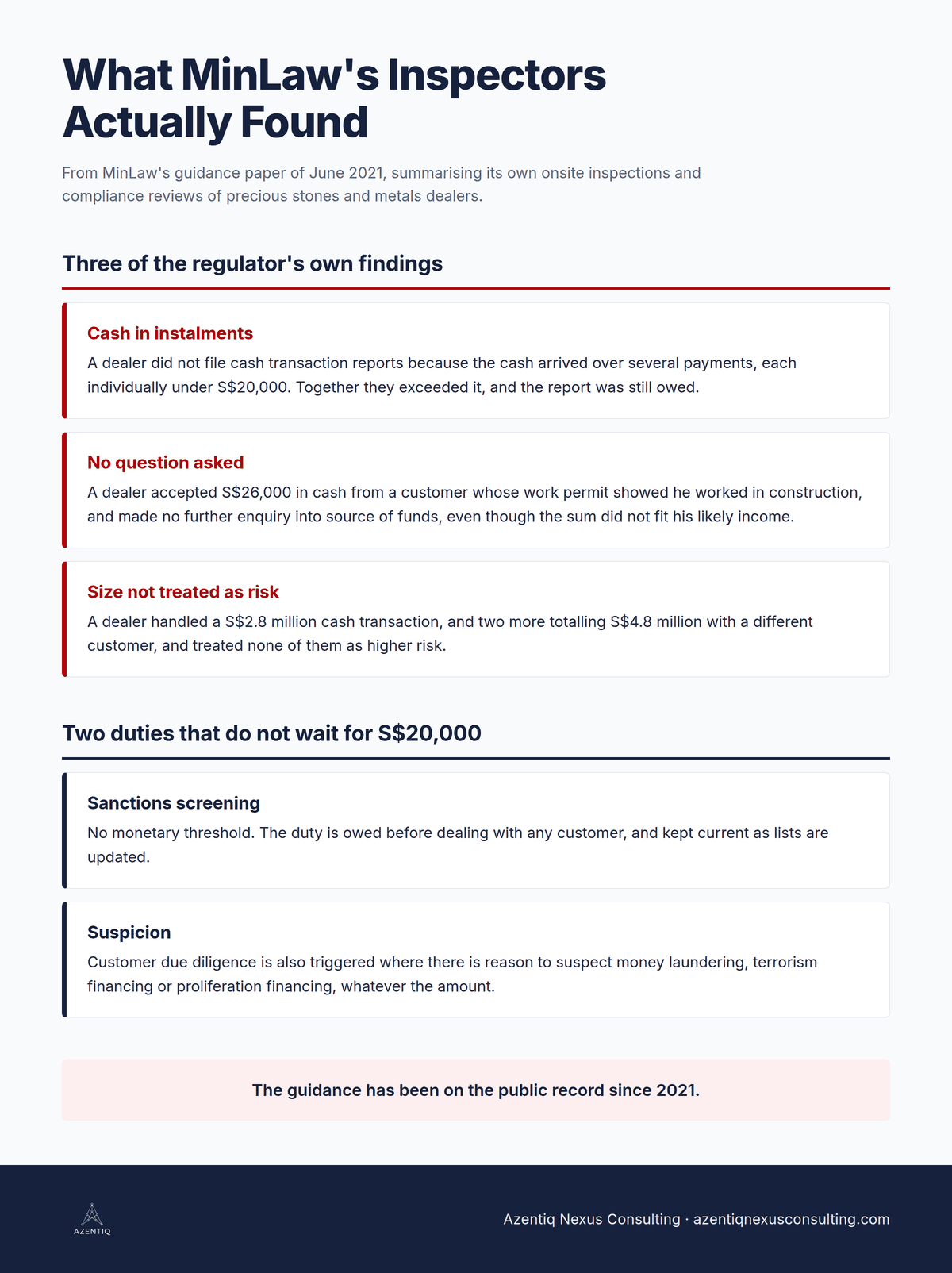
A dealer took cash from a customer in several instalments, each one under S$20,000, and filed no cash transaction report because no single payment crossed the line. That is the instalment version of structuring, and the report duty still applied, because the threshold looks at the payment for the transaction as a whole, not at each slice of cash.
Another dealer accepted a S$26,000 cash payment from a customer whose work permit showed he was a foreigner working in construction, and asked nothing further about where the money came from, even though the sum did not fit the customer’s likely income.
A third handled a S$2.8 million cash transaction with one foreign customer, then two more totalling S$4.8 million with a different customer, and did not treat any of them as higher risk despite their being far larger than its usual trade. It leaned on a money-changer receipt as its only corroboration of source of funds.
None of these dealers needed to be dishonest to fail. They needed only to not look closely. Inspection readiness is mostly the habit of looking closely, and being able to show that you did.
The obligations, and where dealers trip
The regime is set by the Precious Stones and Precious Metals (Prevention of Money Laundering, Terrorism Financing and Proliferation Financing) Act 2019 and its Regulations, supervised by MinLaw and not by the Monetary Authority of Singapore. The distinction matters, because a dealer who reaches for MAS banking practice imports the wrong regime’s language and, sometimes, the wrong obligations.
The threshold attaches to the payment, not the sale
Customer due diligence is the centre of the regime. The trigger is the designated transaction: a transaction where cash or a cash equivalent exceeding S$20,000 is received as payment, including two or more sales to the same customer in a single day that together cross that line. The word “exceeding” is exact. S$20,000 on the nose is not over the line; S$20,000.01 in cash is.
Three misreadings of this cost dealers real errors.
The first is thinking the threshold attaches to the sale. It does not. It attaches to the payment. A S$50,000 sale settled by bank transfer is not a designated transaction, because a bank transfer is neither cash nor a cash equivalent. A cash equivalent is a narrow, closed category defined in the Regulations, centred on payment forms that pass value anonymously, and anything outside cash and that category does not start the designated-transaction machinery.
The second is the instalment trap from the case above. Splitting the cash into payments each below S$20,000 does not take the transaction below the threshold, and MinLaw’s own paper says so in terms.
The third is reading the bank-transfer point too broadly. An account-to-account transfer is not cash, but cash deposited over the counter into the dealer’s own bank account is. MinLaw treats cash paid into a dealer’s Singapore bank account as a cash payment received in Singapore, so the threshold still bites and the dealer must identify the person who made the deposit, not only the customer. In one of MinLaw’s cases a foreign customer had a money-changer deposit the cash into the dealer’s account, and the dealer did no due diligence on the person who paid.
Digital payment tokens: a different trigger, not the same one
Payment in digital payment tokens is where a well-meaning dealer over-reports. A digital payment token is not a cash equivalent; Regulation 3(1) sets a closed list that does not include it. So a token payment does not create a designated transaction. What it does do, once its value exceeds the threshold, is trigger customer due diligence as a prescribed circumstance under Regulation 4A(1)(c), restated at Guideline 6.1.1(f), which pulls in the CDD measures in Regulations 5 and 6. It does not pull in the cash transaction report duty.
The practical point is worth stating plainly, because getting it wrong is expensive in the other direction: a dealer who believes a token payment is a designated transaction will file cash transaction reports it does not owe, and create a paper record that says it misunderstands its own obligations.
Sanctions screening is a duty you owe the customer, not the sale
Screening is where the no-threshold rule lives, and it is easy to state it in a way that is subtly wrong. Screening is not a per-transaction check that switches on above some value. Regulation 16, read with section 20 of the Act, puts it directly: a dealer must, before dealing with any customer, take reasonable measures to assess whether that customer, anyone acting on their behalf, or a beneficial owner is a terrorist or terrorist entity, or a designated person under the United Nations regulations. There is a third limb too, and it is the one a dealer cannot find on any public list: a person the Registrar has notified the dealer about directly. There is no monetary threshold in any of this. Whether the item costs S$100 or S$100,000, the customer is screened, because the duty attaches to the person you are dealing with, not the size of the deal.
Record keeping: five years, and no inventing what it covers
You must retain transaction records and CDD documents for at least five years. That is Regulation 13(1), and it is firm. Inspectors do not just want the final receipt; they want a trail that shows when screening happened and what it returned.
Two of MinLaw’s findings here are almost mundane. One dealer lost copies of identity documents after passing them to its head office. Another kept ID copies that were unclear and illegible. Neither is exotic. Both would fail an inspection, because a record you cannot produce or cannot read is, for the inspector’s purposes, a record you do not have.
Gold as payment: now a prescribed circumstance
Gold is worth its own note, because the position has hardened. Where a dealer receives gold, other than in the form of jewellery, exceeding the threshold as payment, that is a prescribed circumstance under Regulation 4A(1)(a), and CDD under Regulations 5 and 6 must be performed, just as for a designated transaction. MinLaw’s 2021 guidance paper, written before this was prescribed, put it more softly: it noted that gold bars are high value and allow anonymity, carry higher money laundering and terrorism financing risk, and that dealers were strongly encouraged to conduct CDD on such payers. Note the widening as well as the hardening. The paper spoke specifically of gold bars, while the Regulation reaches all gold other than jewellery. What the paper encouraged in 2021 is, above the threshold, now required.
The parts of readiness dealers most often miss
The risk assessment, by its real name
Every dealer must document a risk assessment covering its customers, the countries those customers come from or where it operates, and its products, services, transactions and delivery channels, keep it current, and produce it to the Registrar on request. MinLaw publishes a sample form, Annex A to its Guidelines, that a dealer may build on, but it has to be adapted to the business rather than filled in as it stands. The Guidelines also expect senior management to review and approve the assessment periodically so it keeps pace with how the business actually trades.
A note on language, because it matters in this sector. This document is sometimes called an enterprise-wide risk assessment, but that phrasing belongs to the MAS and banking world. The PSPM instrument is simply the risk assessment required under the Regulations. Using the banking term inside the one regime that is defined by not being MAS is a small tell that the framework was borrowed rather than built.
The independent audit
This is the requirement dealers most often do not know they carry. A dealer carrying out designated transactions must have an independent audit function to test its policies, procedures and controls. That function can sit inside the business, provided the people running it are independent of the sales side and had no hand in building the programme. An inspector will expect to see it.
The appointed compliance officer
Smaller, and the same shape. The regime requires a compliance officer to be appointed. An inspection will surface quickly whether that appointment is real and understood, or a name on a form.
Training that staff can actually use
MinLaw expects every staff member to understand their own duties, not just the compliance officer. In one finding, a dealer’s sales staff were simply unaware of common red flags. Front-line staff should be able to explain, in their own words, how they spot suspicious behaviour and handle a high-value cash payment. The Guidelines expect this to be documented, with a training log showing dates, attendees and content. Mock interviews and short internal quizzes are a good way to make sure a nervous staff member does not freeze when asked.
Reporting: two channels, and one portal with a real name
Semi-annual returns
Returns are filed twice a year through myPal, MinLaw’s portal at eservices.mlaw.gov.sg/mypal, accessed with Singpass. You file within 30 days of a period ending, which is why the deadlines fall on 30 July and 30 January: the July return covers 1 January to 30 June, and the January return covers 1 July to 31 December. MinLaw confirms the date to each dealer directly and has sometimes allowed a day beyond this, so work to the date above and check your own notification. A late or messy return signals a lack of control, and can invite a closer look at everything else.
Suspicious transaction reports
The PSPM Act carries this at section 21, which requires a dealer, where the circumstances call for it, to make a disclosure under either section 45(1) of the Corruption, Drug Trafficking and Other Serious Crimes (Confiscation of Benefits) Act or sections 8 or 10 of the Terrorism (Suppression of Financing) Act, whichever applies. In plain terms, you file a suspicious transaction report with the Suspicious Transaction Reporting Office when you have grounds to suspect criminal conduct, and a copy of that disclosure goes to the Registrar. The value of the trade is irrelevant. What matters is that your staff know when a report is owed and how to escalate it, so the decision is not being made for the first time under pressure.
What non-compliance costs
The figures should be quoted with care. Under section 16 of the Act, failing to comply with the relevant subsections carries a fine of up to S$100,000. It is a ceiling, not a fixed charge, so the honest framing is “up to.” Beyond financial penalties, the Registrar of Regulated Dealers can suspend a registration for up to six months, or cancel it, on the grounds set out in the Act, which ends the ability to trade lawfully. The point of readiness is to keep that machinery pointed elsewhere.
What good looks like
The same paper records dealers who got it right, and they are worth copying. One ran a structured training programme and put CDD and cash-transaction-report reminders on posters in its retail outlets. One kept its list of higher-risk jurisdictions genuinely up to date. One ran weekly checks on its own transactions, caught cash transaction reports it had missed, and filed them before anyone asked. That last habit, checking your own work on a schedule and fixing what you find, is the closest thing the paper offers to a single description of a ready dealer.
Being ready, in practice
Readiness is a state, not a scramble. Run your own health check before MinLaw runs theirs, reading your controls the way an inspector would and fixing gaps in your CDD records, screening logs and returns while it is still cheap to do so. On the day, give the inspectors a quiet workspace and immediate access to both digital and physical files. Organisation is itself a signal: a dealer who can produce the right record in a minute is telling the inspector something a dealer who is still searching cannot.
None of this requires you to work alone. Azentiq Nexus Consulting works with regulated dealers to read their frameworks against MinLaw’s expectations and close the gaps before an inspection, drawing on operational experience across multiple jurisdictions. If you want a professional view of where you stand, you can book a free 15-minute compliance review.
Disclaimer
This article is published by Azentiq Nexus Consulting LLP. It is general information about regulatory obligations. It is not legal advice, and it is not compliance advice for your particular circumstances.
Azentiq Nexus Consulting LLP is a compliance consultancy. We are not a law firm and we do not advise on law. We are not licensed by the Monetary Authority of Singapore and we are not registered with the Ministry of Law. We advise regulated firms; we are not one.
Regulations, thresholds and published guidance change. This article reflects our understanding at the time it was written and may not reflect the current position. Always check the current text published by the relevant regulator, and take advice on your own facts before acting.
Reading this article does not create a client relationship.
Frequently asked questions
- What triggers customer due diligence for a precious stones and metals dealer?
- A designated transaction: one where cash or a cash equivalent exceeding S$20,000 is received as payment, including two or more sales to the same customer in a single day that together cross that figure. The threshold attaches to the payment, so a S$50,000 sale paid by bank transfer is not a designated transaction, while S$46,000 of cash split across three instalments still is.
- Does a payment in digital payment tokens create a designated transaction?
- No. A digital payment token is not a cash equivalent, so a token payment does not create a designated transaction or a cash transaction report duty. A token payment exceeding S$20,000 does trigger customer due diligence as a prescribed circumstance under Guideline 6.1.1(f), pulling in the CDD measures in Regulations 5 and 6.
- When are semi-annual returns due, and where are they filed?
- They are filed through myPal, MinLaw's portal, using Singpass. Each return is filed within 30 days of its period ending, so the deadlines are 30 July and 30 January, with MinLaw confirming the exact date to each dealer directly, so check your own notification.
- Does sanctions screening have a monetary threshold?
- No. Screening is a duty owed before dealing with any customer, with no monetary floor, and it continues as sanctions lists are updated. A S$100 sale is screened on the same basis as a S$100,000 one, because the duty attaches to the customer rather than the transaction.
- How long must records be kept?
- At least five years, under Regulation 13(1), covering transaction records and CDD documents. The test an inspector applies is whether you can produce a clear, legible record on request.
- Is Azentiq Nexus Consulting a law firm?
- No. Azentiq Nexus Consulting is a specialist compliance consultancy. It does not provide legal advice, opinions or drafting. It works alongside a dealer's team on operational AML/CFT systems built against MinLaw's expectations.
Scale With Trust
Weekly compliance briefings for regulated firms in Singapore. Every Friday. No spam.
By subscribing, you agree to receive emails from Azentiq Nexus Consulting.