
PSPM Act Dealer Registration in Singapore: A Step-by-Step Guide
Registration is the gateway, not the destination. A dealer who treats the Ministry of Law application as a one-off form and stops there has done the easy part and skipped the real one, which is the anti-money-laundering and countering-the-financing-of-terrorism programme that sits behind the certificate. This guide walks through both: who has to register, what the application actually asks for, what the programme has to contain before you apply, the fees, and the duties that keep your standing once you are in.
Who must register under the PSPM Act 2019
The PSPM Act 2019 covers regulated dealers and intermediaries who handle precious stones, precious metals and precious products. The logic is straightforward: high-value goods that are easy to move and easy to liquidate are attractive to anyone laundering money, so the sector is brought inside the AML and CFT net. Getting your own status right is the first thing to settle, because it decides everything that follows.
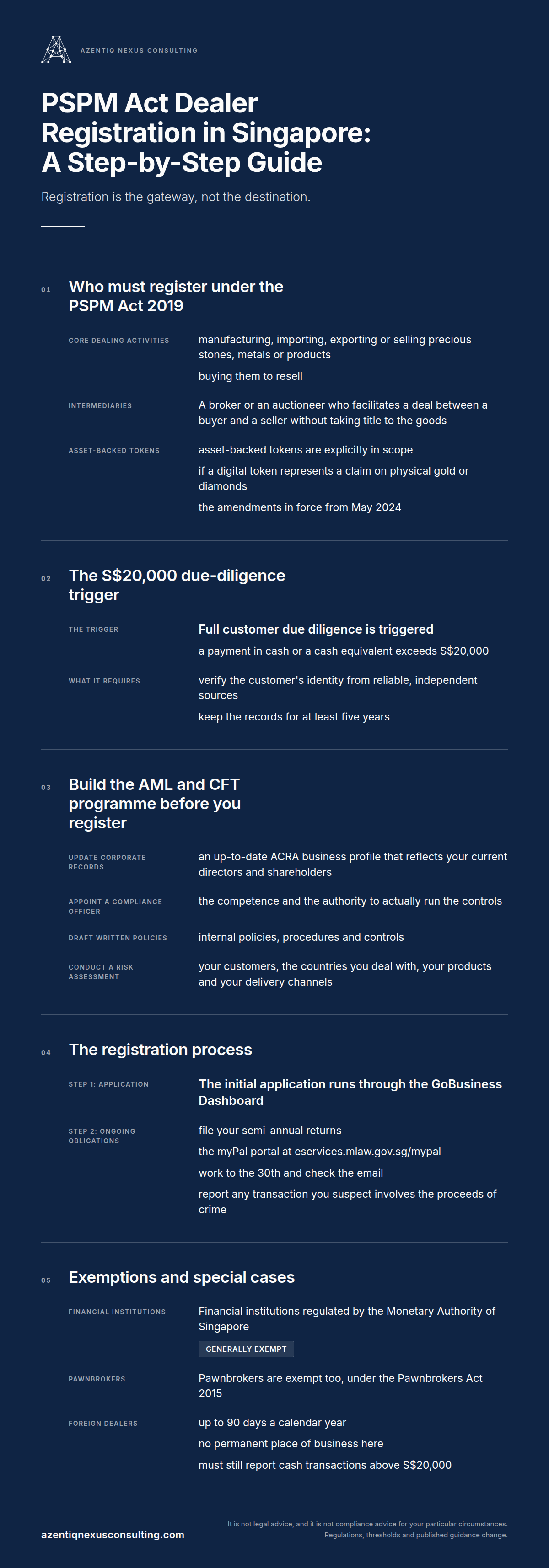
Regulated dealing means manufacturing, importing, exporting or selling precious stones, metals or products, and buying them to resell. Since the amendments in force from May 2024, a precious product is a finished item where at least half the value comes from its precious components, and asset-backed tokens are explicitly in scope: if a digital token represents a claim on physical gold or diamonds, the dealer or issuer is likely to fall under the Ministry of Law regime.
The scope of regulated dealing
The regime does not care whether you are a high-street jeweller or a wholesale bullion trader. If you trade in gold bars, loose diamonds or luxury jewellery at the value threshold, you are in. Intermediaries are in too. A broker or an auctioneer who facilitates a deal between a buyer and a seller without taking title to the goods is caught by the activity of facilitation, and this is the requirement we most often see overlooked, because firms assume registration is only for those who hold stock.
Exemptions and special cases
Not everyone touching precious metals needs a separate registration. Financial institutions regulated by the Monetary Authority of Singapore, including banks and certain payment institutions already under AML and CFT supervision, are generally exempt. Pawnbrokers are exempt too, under the Pawnbrokers Act 2015. Foreign dealers have a narrow exemption: they can operate in Singapore for up to 90 days a calendar year, typically for trade fairs, provided they have no permanent place of business here, but they must still report cash transactions above S$20,000. For the underlying legislation, our PSPM Act explained guide sets out the framework.
Registration requirements and documentation
The application asks for more than a business profile. You have to show the Ministry of Law that your structure and your key people meet its standards. Start with an up-to-date ACRA business profile that reflects your current directors and shareholders, since that is the primary check on your corporate existence and ownership.
Every applicant appoints a compliance officer. That person oversees the AML and CFT framework and is the main point of contact for the Registrar. A small firm may not need a dedicated hire, but whoever is appointed needs the competence and the authority to actually run the controls. You provide identity documents for all key personnel, NRIC copies for citizens and permanent residents or passports for foreign directors.
The fit and proper test
The Registrar applies a fit and proper test to every director and shareholder, looking at integrity, financial standing and past conduct: convictions involving fraud or dishonesty, or adverse findings by other regulators. The thing worth saying plainly is that non-disclosure of a past regulatory issue tends to cause more trouble than the issue itself. We help firms prepare for this by reviewing the background and making sure every declaration is accurate and complete before it goes in.
Cash equivalents, and where firms get the list wrong
Your internal policy has to define cash equivalents correctly, because the S$20,000 due-diligence trigger counts cash and cash equivalents, not just banknotes. A cash equivalent is a narrow, closed category set out in Regulation 3(1) of the PMLTFPF Regulations 2019, a specific list rather than an open class: a cash cheque or traveller’s cheque, a payment account containing e-money, a voucher redeemable for goods or services, a token, stamp, coupon or other article that entitles the holder to receive any precious stone, precious metal or precious product, and a negotiable instrument in bearer form or transferable by delivery. The way to classify a payment is to check it against that list, not to reason from what it looks like. An ordinary crossed cheque is not on the list, because it clears through a bank account and the payer is traceable, and neither physical gold nor a digital payment token is a cash equivalent under this regulation.
Build the AML and CFT programme before you register
Registration is an attestation that you are ready, so the written AML and CFT programme has to exist before you apply, not after. The PMLTFPF Regulations 2019 require dealers to put internal policies, procedures and controls in place, and the programme should reflect how your business actually runs rather than a generic template. A real programme is also what tells the Registrar you understand the specific risks in your part of the sector.
The foundation is the risk assessment. You work through your exposure across your customers, the countries you deal with, your products and your delivery channels, and that lets you put scrutiny where the risk is highest. The Ministry of Law leaves the design of the assessment to you, provided it is thorough and documented, which is the point at which most firms want a second pair of hands to justify their risk ratings.
The threshold for customer due diligence
Full customer due diligence is triggered when a payment in cash or a cash equivalent exceeds S$20,000. This threshold belongs to the precious stones and metals regime and is not the same as the triggers in the MAS-regulated sectors. When you cross it, you verify the customer’s identity from reliable, independent sources, and you keep the records for at least five years.
Sanctions screening and ongoing monitoring
Sanctions screening carries no threshold at all. You screen every customer against the relevant lists before entering into any transaction or relationship, whatever the value, and a positive match means you stop and escalate rather than proceed. Staff training sits alongside this: the Guidelines expect all relevant employees to be trained on the law and on your own procedures, and training is what turns a written control into something that actually happens at the counter.
The registration process and the fees
Once the programme is in place, the submission is entirely digital and uses Singpass for Business. The initial application runs through the GoBusiness Dashboard, and the Ministry of Law uses the myPal portal for ongoing regulatory interactions after that. Precision matters: any mismatch between your ACRA profile and your application particulars slows the approval down.
Most firms receive in-principle approval once the Registrar has completed the fit and proper assessments. You then pay the registration fee to secure your certificate. You can register for one, two or three years rather than only a single year, and the fee is charged as an annual rate for the period you choose, so it is worth deciding your registration period deliberately rather than defaulting to annual renewal.
The myPal portal
The myPal portal, at eservices.mlaw.gov.sg/mypal, is the hub for your relationship with the Ministry of Law. You use it to manage your business particulars and to register each place of business, so a new outlet or a changed showroom location has to be updated there. It is also where you file your semi-annual returns.
Fee categories and validity
The fees split into two classes by the value of what you sell. Class A registration is for dealers where the net price of every item sold is under S$2,000, at an annual rate of S$250 per outlet. Class B registration allows sales of any value and runs at an annual rate of S$350 per outlet. A one-off application fee of S$120 applies to every new submission whatever the class.
Trading without a valid registration is not a small risk. Under the PSPM Act 2019, carrying on regulated dealing while unregistered carries a fine of up to S$75,000 and possible imprisonment. Keeping your registration current and your outlets correctly registered is the simplest way to stay clear of that.
Keeping your status, and the semi-annual return
Holding your registration is a shift from application to operation, and the first ongoing duty is the disclosure of suspicion. Under the Corruption, Drug Trafficking and Other Serious Crimes (Confiscation of Benefits) Act, you must report any transaction you suspect involves the proceeds of crime. That duty is absolute: it applies whatever the value of the trade, and it is separate from the S$20,000 cash-transaction reporting threshold. Keeping the periodic return and the disclosure of suspicion clearly apart in your own mind is worth doing, because they are different obligations with different triggers.
The semi-annual return
The semi-annual return covers 1 January to 30 June and 1 July to 31 December. You file within 30 days of the period ending, so 30 July and 30 January. MinLaw emails each dealer its own filing date, and in practice that date is usually a day later, 31 July and 31 January. Your notification governs, so work to the 30th and check the email.
Inspection readiness
A Ministry of Law inspection is a methodical review of your controls, and the Registrar expects your written policies to be followed in practice. Inspectors will usually look at your risk assessment and your records for transactions above S$20,000, so a clear audit trail on your customer due diligence is what carries you through. A compliance health check before an official visit is the cheapest version of all of this, because it finds the weak points in your record-keeping or screening while there is still time to fix them, rather than after they become findings.
If you would like a practitioner view of where your framework stands before you register, or before an inspection, you can book a scoping call with Azentiq Nexus Consulting to talk it through.
Disclaimer
This article is published by Azentiq Nexus Consulting LLP. It is general information about regulatory obligations. It is not legal advice, and it is not compliance advice for your particular circumstances.
Azentiq Nexus Consulting LLP is a compliance consultancy. We are not a law firm and we do not advise on law. We are not licensed by the Monetary Authority of Singapore and we are not registered with the Ministry of Law. We advise regulated firms; we are not one.
Regulations, thresholds and published guidance change. This article reflects our understanding at the time it was written and may not reflect the current position. Always check the current text published by the relevant regulator, and take advice on your own facts before acting.
Reading this article does not create a client relationship.
Frequently asked questions
- What is the registration fee for a precious metals dealer in Singapore?
- There is a one-off application fee of S$120 for a new submission through the GoBusiness Dashboard. After in-principle approval you pay the registration fee, charged as an annual rate: S$250 per outlet for Class A dealers, and S$350 per outlet for Class B. You can register for one, two or three years, so the total depends on the period you choose.
- Is there a minimum transaction threshold for sanctions screening?
- No. Sanctions screening has no monetary threshold. You screen every customer before entering into any regulated transaction or relationship, unlike customer due diligence, which is triggered by a payment exceeding S$20,000. The duty to avoid dealing with a sanctioned person or entity is absolute.
- How do I file the semi-annual return for my PSPM registration?
- Through the myPal portal at eservices.mlaw.gov.sg/mypal. The periods are 1 January to 30 June and 1 July to 31 December, and you file within 30 days of the period ending, so 30 July and 30 January. MinLaw emails each dealer its own date, usually a day later, so work to the 30th and check the email.
- What counts as a cash equivalent under the PSPM Act 2019?
- Regulation 3(1) of the PMLTFPF Regulations 2019 sets out a closed list: a cash cheque or traveller's cheque, a payment account containing e-money, a voucher redeemable for goods or services, a token or stamp or coupon or other article that entitles the holder to receive any precious stone, precious metal or precious product, and a negotiable instrument in bearer form. Classify a payment by checking it against that list. An ordinary crossed cheque is not on it, because it is traceable through the banking system.
- Does the S$20,000 threshold apply to digital payment tokens?
- The S$20,000 due-diligence threshold applies to payments in cash or cash equivalents, and a digital payment token is not a cash equivalent under Regulation 3(1). Digital payment token services are separately regulated under the Payment Services Act. But if you trade in asset-backed tokens that represent a claim on physical precious stones or metals, you may fall under the PSPM regime, so it is worth checking your specific token structure.
- Can Azentiq Nexus Consulting act as my named compliance officer?
- No. We do not act as a named or outsourced compliance officer. The Ministry of Law expects that person to sit inside the registered dealer. We back your internal team with advisory support, programme design and staff training, so your own compliance officer has what they need, and your firm keeps control of its regulatory decisions.
- What happens if I fail a MinLaw inspection?
- If an inspection finds deficiencies, the Registrar usually issues a list of findings to remediate. We help dealers work through that remediation and redesign the controls behind each gap. The thing that matters is acting quickly once the findings land, because a prompt, documented response is itself evidence of a firm that takes its obligations seriously.
- How often must I run AML and CFT staff training?
- The Guidelines for Regulated Dealers expect all relevant employees to be trained on the law and on the firm's own procedures. The Act does not fix a frequency, but at least once a year, and again after any significant change to the PMLTFPF Regulations 2019, is a sensible baseline.
Scale With Trust
Weekly compliance briefings for regulated firms in Singapore. Every Friday. No spam.
By subscribing, you agree to receive emails from Azentiq Nexus Consulting.