
Developing a Compliance Remediation Roadmap: A Template for Regulated Firms
A regulatory finding is rarely a simple checklist error. It is an invitation to show that you understand the structural gaps in your AML/CFT framework, not just the symptoms of them. Receiving a list of deficiencies after an MAS or MinLaw inspection creates immediate pressure, and many firms are unsure how to prioritise corrections while keeping the business running. The complexity of cross-border rules only adds to that, particularly when the worry about repeat findings hangs over the next assessment.
This guide sets out a structured template for turning those findings into a plan. Azentiq Nexus Consulting works with firms to address the root causes of regulatory findings rather than patch the surface, and the steps below show how to categorise gaps, assign accountability, and build a programme your in-house team runs with specialist support behind it.
Defining the roadmap for regulated firms
A compliance remediation roadmap is a time-bound project plan built to correct deficiencies identified during a health check or a formal regulator inspection. It is a bridge. It moves an organisation from its current state of non-compliance to a position of durable regulatory stability. For senior management, it is a strategic, evidence-based document that provides a clear audit trail of corrective actions and how resources were allocated. It is the record of how a firm intends to restore its own integrity.
When you present it to a regulator like the Monetary Authority of Singapore (MAS) or the Ministry of Law (MinLaw), it is tangible evidence of proactive governance. It shows the firm is not merely reacting to criticism but methodically addressing systemic issues. Staying compliant takes more than fixing a single file. It takes a structured overhaul of the processes that let the gap form in the first place, and a good roadmap gives the regulator confidence that the firm understands its obligations and intends to meet them.
When a roadmap is required
A roadmap becomes necessary whenever the distance between your current AML/CFT framework and the regulator’s expectations becomes visible. That usually happens after a formal inspection where specific findings were issued. It also happens after a compliance health check surfaces significant gaps that could lead to future penalties, and when your business model changes or you expand into new jurisdictions, where a programme overhaul is often needed to keep pace with new risk profiles and new instruments.
The cost of poor remediation planning
Firms that treat remediation as a box-ticking exercise tend to pay for it. Weak planning leads to repeat findings. Repeat findings are read as a governance problem rather than a technical one, because they suggest an earlier warning was handled superficially.
Beyond the risk of fines, a lack of structure drains resources. Without a clear plan, teams fix symptoms and leave the root causes untouched, which does nothing to reduce the actual financial crime risk and leaves the firm exposed. A structured roadmap makes sure that every dollar spent on compliance buys a more secure and defensible business rather than a temporary patch.
The core components of a remediation template
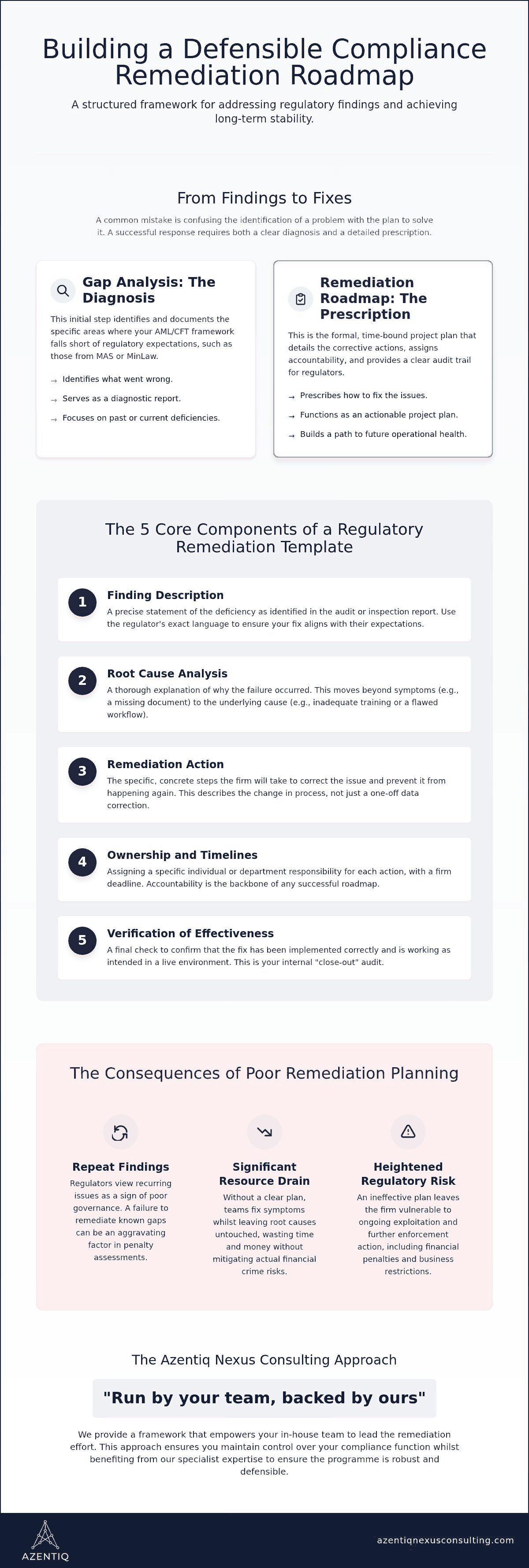
A professional roadmap is more than a task list. It is a structured record of accountability, and to satisfy local regulators it needs to move past vague intentions and show, in detail, how each deficiency is being addressed. We recommend a template with five fields.
- Finding description. A precise statement of the deficiency as identified in the audit or inspection report. Do not paraphrase. Use the regulator’s exact language so the fix maps to what they raised.
- Root cause analysis. An explanation of why the failure happened, whether that is inadequate oversight, flawed software logic, or the absence of a clear internal policy.
- Remediation action. The specific steps to fix the issue and stop it recurring, described as a change in process rather than the correction of a single data point.
- Ownership and timelines. A named individual against each task, with a firm deadline. Without an owner, remediation stalls.
- Verification of effectiveness. A final check that the fix actually works in a live environment. This is your internal close-out before the next inspection.
Addressing the root cause
Regulators expect firms to look past the surface error to the systemic weakness underneath. If a Customer Due Diligence file is missing, the root cause may be a gap in AML/CFT staff training rather than a clerical slip, and fixing the process matters far more than patching the one file. A good roadmap prioritises these structural fixes so the same gap does not reappear in six months.
Prioritising findings by risk
Not all findings carry the same weight, and a sensible roadmap tiers the work by the severity of the regulatory risk. The ones worth taking first are direct breaches of the PSPM Act 2019 or the Payment Services Act, which touch your registration or licence and your reputation and are the ones we would address before anything else. Medium-priority items tend to be documentation updates or policy refinements that strengthen the framework without representing an immediate control failure. Low-priority items are usually administrative improvements that help efficiency without directly affecting AML/CFT effectiveness. Tiering the work this way shows the regulator you have a firm grip on your own risk profile.
Gap analysis against remediation: the finding and the fix
The distinction between a gap analysis and a remediation plan matters for any firm regulated by MAS or MinLaw. A gap analysis is a diagnostic tool. It identifies precisely what is missing and highlights the distance between your current controls and the standard set by the PSPM Act 2019 or the Payment Services Act. But knowing where you fall short does not satisfy the regulator. The roadmap is the prescription. It sets out the method for filling those gaps and making sure they do not recur.
Firms often make the mistake of stopping at the diagnostic stage. They receive a report detailing deficiencies and assume the work is done, which is a dangerous assumption, because an unaddressed gap analysis is just a list of vulnerabilities you have acknowledged and not fixed. The roadmap is the execution phase that turns those observations into operational reality.
From discovery to action
Moving from discovery to action takes a shift in focus. Once gaps are identified, senior management has to approve the resources to execute the roadmap, whether that is budget for new software, time for staff training, or the engagement of external specialists. It helps to socialise the roadmap across departments early, because when operations, finance and compliance all understand the plan, buy-in rises and the sense of panic that comes with scrutiny gives way to a methodical, tiered approach.
Documenting the progress
A roadmap is a living document, not a static file to be archived. It should be updated as tasks are completed and verified, and old versions retained, because that history is a clear audit trail. It shows the evolution of your controls and the sincerity of the effort, and when a regulator asks for proof of progress, a well-maintained roadmap is the answer.
A step-by-step guide to executing the plan
Executing a roadmap takes a methodical, phased approach rather than enthusiasm. Many firms struggle because they treat remediation as one task instead of a project with distinct phases. To move from deficiency to stability, work through a disciplined sequence so no gap is left unaddressed.
- Step 1: Categorise findings. Group every deficiency by its specific regulatory instrument. Is the failure under the PSPM Act 2019 or the Payment Services Act? This mapping keeps the corrective action aligned with the exact requirement.
- Step 2: Conduct root cause analysis. For every high-risk finding, dig past the symptom. If a transaction was missed, was it human error or a failure in the screening software’s logic?
- Step 3: Draft remediation steps. Make every action specific and measurable. Vague instructions like “improve monitoring” will not satisfy an inspector; specify the exact policy update or technical fix.
- Step 4: Assign owners and deadlines. Every task needs a named individual and a deadline that reflects the urgency of the risk.
- Step 5: Implement verification. Establish a process to confirm the gap is closed permanently, so the same issue does not reappear at your next inspection.
Specifics for PSPM regulated dealers
For dealers in precious stones and precious metals, the roadmap has to be tailored to MinLaw’s expectations. Make sure your remediation addresses the customer due diligence trigger for payments exceeding S$20,000. Make sure proliferation financing is built into your CDD process, as required by Act 6 of 2024. Confirm that sanctions screening is performed for all customers, since that obligation applies regardless of the transaction value. And review your semi-annual return process, which is filed through myPal.
On that return, the detail matters and it is easy to get a day wrong. The semi-annual return covers 1 January to 30 June and 1 July to 31 December. You file within 30 days of the period ending, so 30 July and 30 January. MinLaw emails each dealer its own filing date, and in practice that date is usually a day later, 31 July and 31 January. Your notification governs, so work to the 30th and check the email.
Verification and testing
Closing a task in your tracker is not the same as fixing the problem. Verification is best done by someone who was not involved in the original remediation, to keep it objective. Sampling a small number of files or transactions is a practical way to test whether a new procedure works as intended in a live environment. Document the results clearly, because that creates the audit trail that proves your remediation was a genuine improvement rather than a paper exercise.
Building long-term stability
A remediation roadmap turns identified gaps into a defensible record of institutional integrity. It means moving past simple fixes to the systemic root causes regulators expect you to master, and by categorising findings and assigning clear ownership, you keep the firm ready for the next inspection cycle. That is what proves your governance is proactive rather than reactive.
If you would like a professional view of where your framework stands, you can book a free 15-minute compliance review.
Disclaimer
This article is published by Azentiq Nexus Consulting LLP. It is general information about regulatory obligations. It is not legal advice, and it is not compliance advice for your particular circumstances.
Azentiq Nexus Consulting LLP is a compliance consultancy. We are not a law firm and we do not advise on law. We are not licensed by the Monetary Authority of Singapore and we are not registered with the Ministry of Law. We advise regulated firms; we are not one.
Regulations, thresholds and published guidance change. This article reflects our understanding at the time it was written and may not reflect the current position. Always check the current text published by the relevant regulator, and take advice on your own facts before acting.
Reading this article does not create a client relationship.
Frequently asked questions
- What is a compliance remediation roadmap?
- It is a formal, time-bound project plan designed to correct specific deficiencies identified during a regulator inspection or a health check. It sets out how your firm will move from non-compliance to regulatory stability, and it provides a clear audit trail for management and the regulator, detailing the actions, owners and deadlines needed to strengthen your AML/CFT framework.
- How long does a typical remediation project take?
- It depends entirely on the volume and severity of the findings. Minor administrative updates might be resolved within three months, while systemic overhauls of CDD or transaction monitoring often take six to twelve months to implement and verify. The timeline should reflect the urgency of the risk and leave enough room for thorough testing before the next inspection.
- Must I report my remediation progress to the regulator?
- Only if the regulator has asked you to. Whatever you owe by way of progress reporting is what the regulator issuing the findings has told you it wants, so read the covering letter or direction, because it will say. There is no standing duty in the PSPM instruments to send MinLaw regular progress updates, and where nothing has been directed, none is owed. Keep the record regardless. A maintained roadmap showing what was fixed, when, and who verified it is what you produce at the next inspection, and it is far easier to build as you go than to reconstruct a year later.
- What is the difference between a gap analysis and a remediation plan?
- A gap analysis is a diagnostic exercise that identifies what is missing or failing in your current programme. A remediation plan is the actionable prescription that details how those gaps will be closed. The gap analysis highlights the problem; the roadmap provides the solution, including resource allocation, specific task descriptions and a verification process to make the fix permanent.
- Can a consultant manage the entire remediation process for us?
- A consultant acts as a support function and a strategic guide, but cannot replace your in-house compliance team or take over management responsibilities. At Azentiq Nexus Consulting we work on the principle that compliance is run by your team and backed by ours. We provide the specialist expertise to build your roadmap and advise on execution, but the firm's directors retain ultimate accountability for the programme.
- How do I prioritise findings in a remediation roadmap?
- Prioritisation should follow the severity of the regulatory risk and the impact on your AML/CFT effectiveness. The ones we would take first are breaches of the PSPM Act 2019 or the Payment Services Act, which go to your registration or licence, with medium and low-priority findings such as policy refinements or administrative enhancements following once the critical gaps are closed. This risk-based approach shows the regulator you understand your own vulnerabilities.
- What happens if we fail to meet a remediation deadline?
- Missing a deadline can erode the regulator's trust in your governance. A missed deadline with no explanation is easy to read as weak control, and repeat findings compound that impression. If a delay is unavoidable, it is best to communicate early with the regulator, providing a revised timeline and a clear explanation.
- Does Azentiq Nexus Consulting guarantee a positive regulatory outcome?
- No. We do not guarantee a regulatory outcome, a licence approval, or the avoidance of penalties. Our role is to provide precise advisory support and hands-on guidance based on practitioner experience in regulated financial businesses. We help you build a robust framework and a defensible roadmap, but the final assessment of your programme rests entirely with the relevant regulator.
Scale With Trust
Weekly compliance briefings for regulated firms in Singapore. Every Friday. No spam.
By subscribing, you agree to receive emails from Azentiq Nexus Consulting.